
E-oci-card
Renunciation of OCI Card: Process, Documents, Fees & How to Surrender Your OCI Status (2026 Guide)Renunciation of OCI Card: Process, Documents, Fees & How to Surrender Your OCI Status (2026 Guide)
Written by Anil
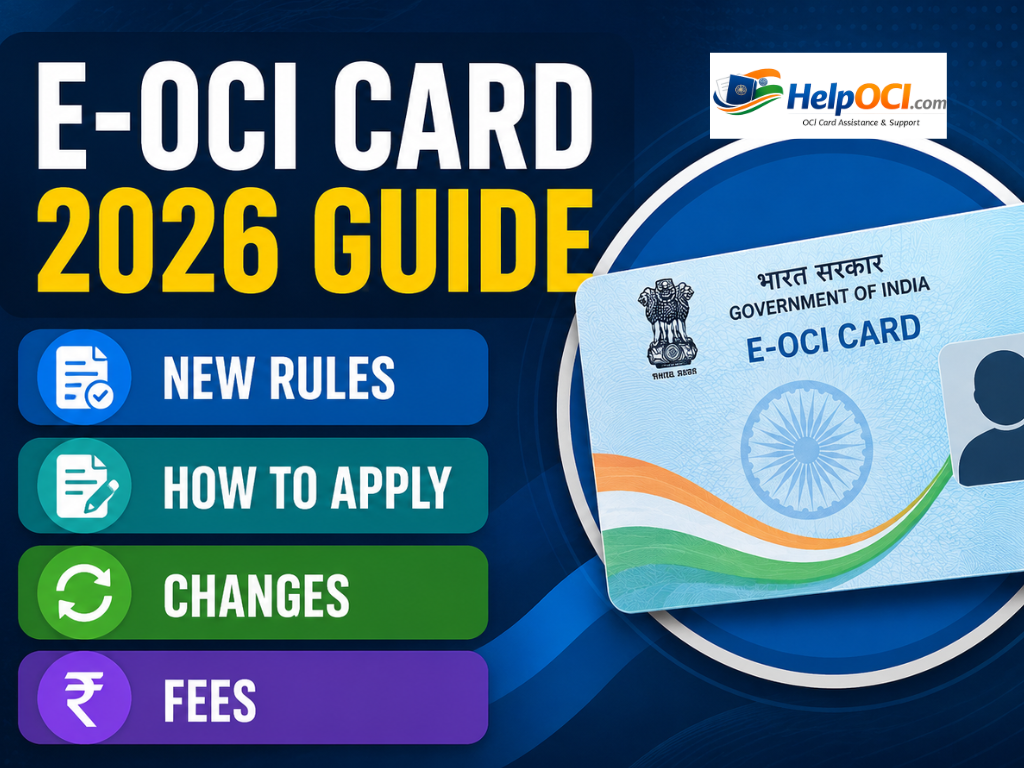
The Government of India launched the Electronic Overseas Citizen of India (e-OCI) Card on 30 June 2026, introducing a digital alternative to the traditional physical OCI card booklet. This new system allows OCI cardholders to download their digital cards and access their OCI details electronically.
The introduction of e-OCI brings important changes to the OCI application process, passport updates, and document management. Existing physical OCI booklets remain valid, while new applicants will receive digital OCI cards instead of newly printed physical booklets.
In this guide, learn everything about the E-OCI Card 2026, including its new rules, eligibility, application process, fees, passport update requirements, and important changes that existing OCI cardholders should know before travelling to India.
Let HelpOCI experts assist you with your E-OCI application, document preparation, and submission process. Get professional assistance and make your application journey easier.
Apply for E-OCI with Expert Help →The Electronic Overseas Citizen of India (e-OCI) Card is a digital version of the traditional OCI card issued by the Ministry of Home Affairs, Government of India.
It allows OCI cardholders to download their OCI card electronically through the official OCI Services Portal. The digital card contains the cardholder's personal details and OCI registration information.
Unlike the traditional physical booklet, the e-OCI card can be stored on a mobile device or downloaded and printed for reference.
The main objective of introducing e-OCI is to simplify the OCI documentation process, reduce paperwork, and make immigration verification easier.
Important: Existing physical OCI booklets remain valid and continue to be accepted for immigration clearance. However, new OCI applicants will receive digital e-OCI cards instead of newly printed physical booklets.
The introduction of e-OCI brings several important changes for new applicants and existing OCI cardholders.
Here are the major changes:
Digital OCI Cards: New applicants will receive digital e-OCI cards instead of physical OCI booklets.
No Physical Booklet Requirement: Existing OCI holders can download their e-OCI cards and use them for immigration clearance without carrying the physical booklet.
Online Passport Updates: OCI holders must update their passport details online whenever a new passport is issued, as required under the applicable OCI guidelines.
Simplified Age 20 Rule: OCI cardholders no longer need to reissue their OCI booklet after receiving a new passport at the age of 20.
Digital Application Process: Applicants can complete the OCI application process online, including submitting documents and downloading the approved digital card.
These changes aim to make OCI services more convenient for overseas Indians and their families.
The e-OCI system is available to both new applicants and existing OCI cardholders.
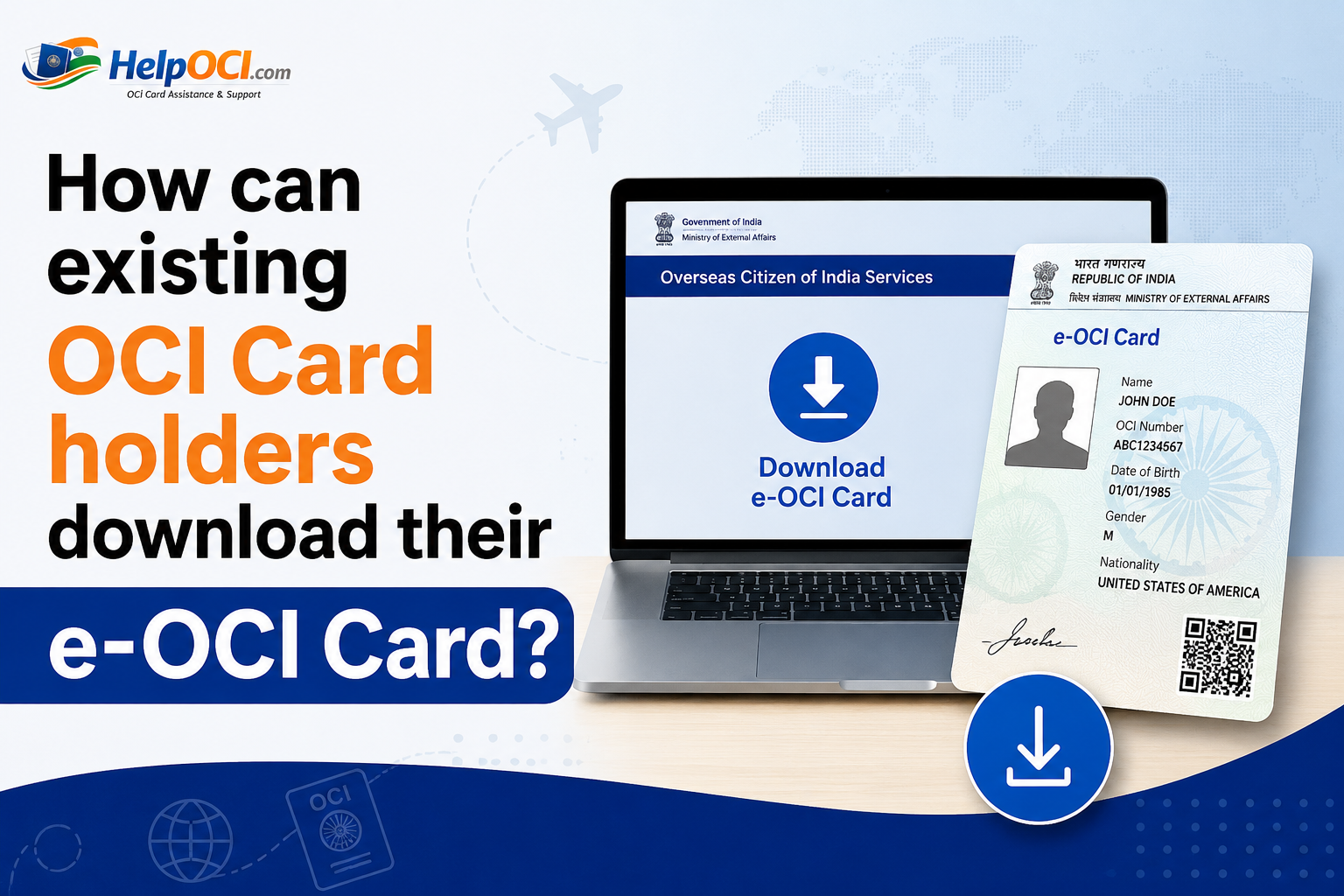
If you already hold a physical OCI booklet, you do not need to apply for a new OCI card. You can log in to the official OCI Services Portal and generate your digital e-OCI card.
Existing physical OCI booklets remain valid for travel and immigration purposes. However, downloading the digital version is recommended so you can easily access your OCI details whenever required.
For new applicants, the Government of India will issue digital e-OCI cards after approval of their applications.
The updated OCI rules also bring changes for minor cardholders.
Previously, minors were required to obtain OCI reissuance whenever they received a new passport until they reached 20 years of age.
Under the updated rules, the requirement to reissue the OCI booklet upon receiving a new passport after turning 20 has been eliminated.
Parents should keep the following points in mind:
Parents must update their child's new passport details through the prescribed online OCI update process.
A new passport does not automatically require a complete fresh OCI application.
The age 20 reissuance requirement has been removed.
Parents should follow the applicable online update and biometric requirements.
This makes managing OCI documents easier for families whose children frequently renew their passports.
One important thing to understand is that downloading an e-OCI card and applying for a fresh OCI registration are two different services.
The e-OCI download facility is free. However, applicants applying for a new OCI registration or requesting other OCI miscellaneous services must pay the applicable government fees.
The following are the commonly applicable government fee amounts:
| OCI Service | Government Fee |
|---|---|
| Fresh OCI Application | $275 |
| OCI Miscellaneous Services | $25 |
| Duplicate OCI Card for Lost or Damaged Card | $100 |
| e-OCI Card Download | Free |
Important: These are government fee amounts, not necessarily the final amount payable. Additional charges, such as ICWF contributions, VFS service fees, courier charges, and payment fees, may apply depending on the country and application route.
For applications submitted in India, the applicable fee is payable in INR as prescribed by the government.
For a detailed breakdown, check our guide on Latest OCI Card Fees in 2026.
The e-OCI system allows applicants to complete the OCI application process digitally through the official Government of India OCI Services Portal.
Follow these steps to understand the application process.
Before applying for an OCI card, first confirm whether you meet the eligibility requirements.
You may be eligible if you are:
A former Indian citizen.
A child, grandchild, or great-grandchild of an eligible Indian citizen or former Indian citizen.
A foreign national married to an eligible Indian citizen or OCI cardholder, subject to the applicable conditions.
Certain restrictions apply, including restrictions relating to applicants with Pakistani or Bangladeshi citizenship or qualifying ancestry.
Once you confirm your eligibility, collect the required documents.
Commonly required documents include:
Current foreign passport.
Proof of Indian origin, such as an old Indian passport or other accepted documents.
Proof of current residential address.
Birth certificate, where applicable.
Marriage certificate for spouse-category applicants.
Parents' documents and proof of relationship for minor applicants.
The exact document checklist depends on your application category and country of residence.
Visit the official Government of India OCI Services Portal.
Follow these steps:
Open the official OCI Services Portal.
Select the appropriate new OCI registration option.
Enter your personal information and passport details.
Complete the application form carefully.
Save your generated Online Registration Number for future reference.
Make sure that all information matches your supporting documents and current foreign passport.
After completing the online application form, upload the required supporting documents.
You will generally need to provide:
Scanned copies of supporting documents in the prescribed format.
A recent passport-size photograph.
Your signature or thumb impression, where applicable.
Photograph Requirements:
Square-shaped photograph.
Minimum dimensions of 200 × 200 pixels.
Clear front-facing photograph with a plain, light-coloured background.
Signature Requirements:
Upload the signature according to the portal's prescribed specifications.
For minors who cannot sign, follow the applicable thumb impression instructions.
Check the portal's latest upload requirements before submitting your application.
Once you have uploaded all the required documents, review your application carefully and complete the submission process.
Follow the payment and verification instructions displayed on the official OCI portal.
The process may include additional verification or requirements from the concerned Indian Mission, Post, or designated service provider, depending on your application category and country.
Always follow the latest instructions provided for your jurisdiction.
After completing the required application steps, pay the applicable OCI government fees and any additional service charges.
Once submitted, keep your application reference number safe.
You can check your application status through the Government of India OCI Services Portal.
After your application is approved, you can access and download your digital e-OCI card.
Processing time may vary depending on the application category, document verification, and the concerned authority.
Need help with the application form or document uploads? Book a consultation with our OCI experts and get step-by-step guidance to complete your application accurately and avoid common mistakes.
Book a 30-Minute Expert Consultation →The introduction of e-OCI has changed the way OCI cards are issued and updated.
Previously, certain passport-related changes required physical OCI booklet reissuance. Under the new system, passport details can be updated electronically through the prescribed online process.
One major change is that OCI cardholders no longer need to reissue their OCI booklet after receiving a new passport at the age of 20.
However, applicants should not assume that every passport or personal-detail change is automatically updated. They must complete the applicable online update process and follow any biometric or verification requirements.
Important: Since fresh physical OCI booklets are no longer being printed, the old physical reissuance instructions should not be treated as the current process. For cases involving the first passport after age 50, check the latest instructions on the OCI portal or with the concerned Indian Mission or FRRO before applying.
Even with the introduction of e-OCI, travellers should ensure that their passport details and OCI records are accurate before travelling to India.
Some common mistakes can lead to unnecessary confusion during airline checks or immigration clearance.
1. Not Updating New Passport Details
One of the most common mistakes is receiving a new passport but forgetting to update the details in the OCI system.
How to avoid it: Whenever you receive a new passport, check whether an OCI passport update is required and complete the prescribed online process.
2. Depending Only on an Old Physical OCI Booklet
Some cardholders may assume that their old physical OCI booklet is no longer valid after the introduction of e-OCI.
How to avoid it: Existing physical OCI booklets remain valid. You can also download your digital e-OCI card for convenient access.
3. Entering Incorrect Passport Details
Incorrect passport numbers, personal information, or other details can create problems during verification.
How to avoid it: Double-check your passport details and application information before submitting any update request.
4. Not Keeping a Digital Copy of the e-OCI Card
Not having access to your digital OCI card when needed can cause unnecessary inconvenience.
How to avoid it: Download your e-OCI card from the official portal and save a copy on your mobile device. You may also keep a printed copy for reference.
The introduction of the e-OCI Card in 2026 is an important step towards making OCI services more convenient and digitally accessible for overseas Indians.
With digital card issuance, online passport updates, and simplified reissuance requirements, the new system reduces the dependence on physical OCI booklets.
Existing OCI cardholders can continue using their valid physical booklets or download their digital e-OCI cards through the official portal. New applicants can complete their applications online and receive their digital cards after approval.
The most important thing for all OCI holders is to keep their passport details updated, maintain access to their digital OCI card, and follow the latest government guidelines before travelling to India.
Note: This guide is for information purposes only. HelpOCI or the author will not be responsible for any direct or indirect loss incurred by the reader for taking any decision based on the information or the contents. It is advisable to consult a qualified professional for guidance based on your exact situation.
Get reliable support for every step, whether it's form filling or final submission.




Want to read more? Explore Blogs
Comments