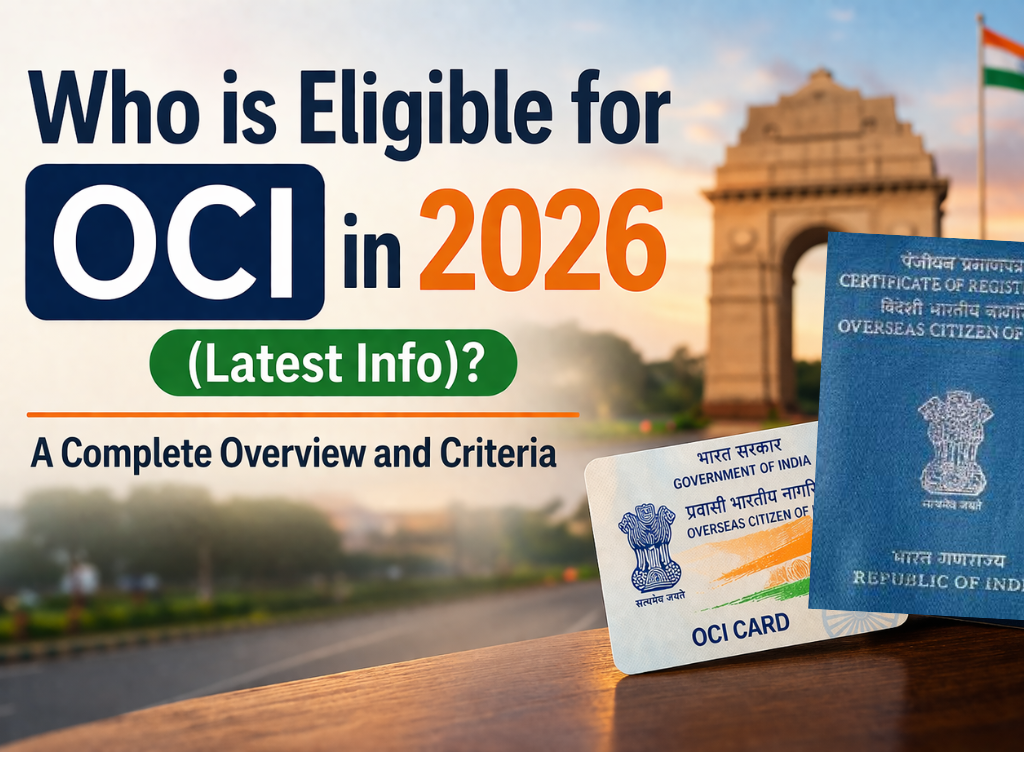
If you're of Indian descent living outside of India, getting an Overseas Citizen of India (OCI) card is the next best thing to getting dual citizenship. It's a lifetime visa for you to reside, work, and invest in India. The Ministry of Home Affairs (MHA) has done a significant revamp to the OCI program. If you're wondering "Who is eligible for OCI card?", it's important to understand both the foundational pillars as well as these new 2026 rule updates. Here's the most comprehensive, timely guide to OCI eligibility, newly broadened rules, and key restrictions.
The 2026 OCI Rule Changes
The Indian government has updated the OCI framework to be wider in scope and stricter in digital compliance. There have been three major changes recently:
- Broadened Lineage for Sri Lankan Tamils: For 5th and 6th generation Indian Origin Tamils (IOTs) in Sri Lanka, the previous 4th generation limit is now gone. The government has started to accept local registration and older High Commission records to simplify the process of proving lineage.
- No 6-Month Wait to Apply: There is no longer a 6-month waiting period for foreign nationals arriving on long-term visas to apply for OCI. If your documents are in order, you may apply for OCI when you arrive in India.
- Launch of the e-OCI Card: The government has launched the e-OCI card and introduced faster biometric processing through "e-gates" at major airports in India.
- New Fines for Foreign Passport Holders: If you get a new foreign passport, you'll have to upload your passport information to the OCI online portal within 3 months or else you'll have to pay a fine of $25 USD (in your currency).
Do you want to know More in detail - Check from here-
Core Eligibility Criteria - Who is Eligible for an OCI Card?
If you are a foreign citizen and you fit into one of the categories administered by the
Ministry of Home Affairs, then you qualify for an OCI card.
Direct Indian Origin (Self)
If someone is a foreign citizen who:
- was a citizen of India on or after January 26, 1950,
- was eligible to be an Indian citizen on January 26, 1950, or
- was a citizen of a territory that became a part of India after August 15, 1947, you may now be eligible for OCI.
Lineage (Children, Grandchildren, & Great-Grandchildren)
If you are the child, grandchild, or great-grandchild of a person who is in the direct origin category, you can also apply.
For the Sri Lankan Tamil diaspora only, this lineage extends to the 5th and 6th generations.
Minor Children
A minor child whose both parents are Indian citizens, or whose one parent is an Indian citizen or an OCI cardholder, can also apply.
Foreign Spouses (Marriage-Based OCI)
If you are a foreign citizen and you are married to an Indian citizen or to an OCI cardholder, you may apply. To be eligible to apply,
- you should have legally registered your marriage, and
- your marriage should have been in subsistence for a period of not less than 2 years immediately prior to your applying.
A personal interview at the Indian Embassy or VFS Global center is compulsory for all applications based on marriage relation.
Absolute Ineligibility: Who Cannot Get an OCI Card?
Even if you meet the criteria above, the Government of India strictly bars certain individuals from obtaining an OCI card:
| Exclusion Category |
Details & Exceptions |
| Pakistan & Bangladesh Links |
If you, your parents, grandparents, or great-grandparents were ever citizens of Pakistan or Bangladesh, you are entirely ineligible. |
| Military & Security Personnel |
Foreign defense, military, police, or security agency employees (both active and retired) cannot get an OCI card. |
| Exception to Military Rule |
Retired or active military personnel from Israel are uniquely exempt from this security restriction. |
Advantages of Having an OCI Card
The OCI Card does not replace an Indian passport or grant voting rights, though it comes with its own advantages.
- Lifelong, Multiple-Entry Visa: Makes it possible to visit India at any time without needing to apply for a tourist or business visa.
- No Police Reporting: OCI would no longer be required to register with the FRRO (Foreigners Regional Registration Officer) and/or would not be subject to any limitation on the duration of a continued stay in India.
- Additional Benefits: Consideration is given to economic, financial, and educational areas with Non-Resident Indians (NRIs). This also includes discount rates on domestic airfare and reduced/waived entry fees to National Historic Monuments.
- Professional Flexibility: OCI holders can use their professional services in India as doctors, dentists, nurses; chartered accountants; architects; and advocates (subject to local governing board exams).
Want to check whether you're eligible for an OCI Card?Simply fill in your contact details below, and we'll help you determine your OCI Card eligibility.





Comments