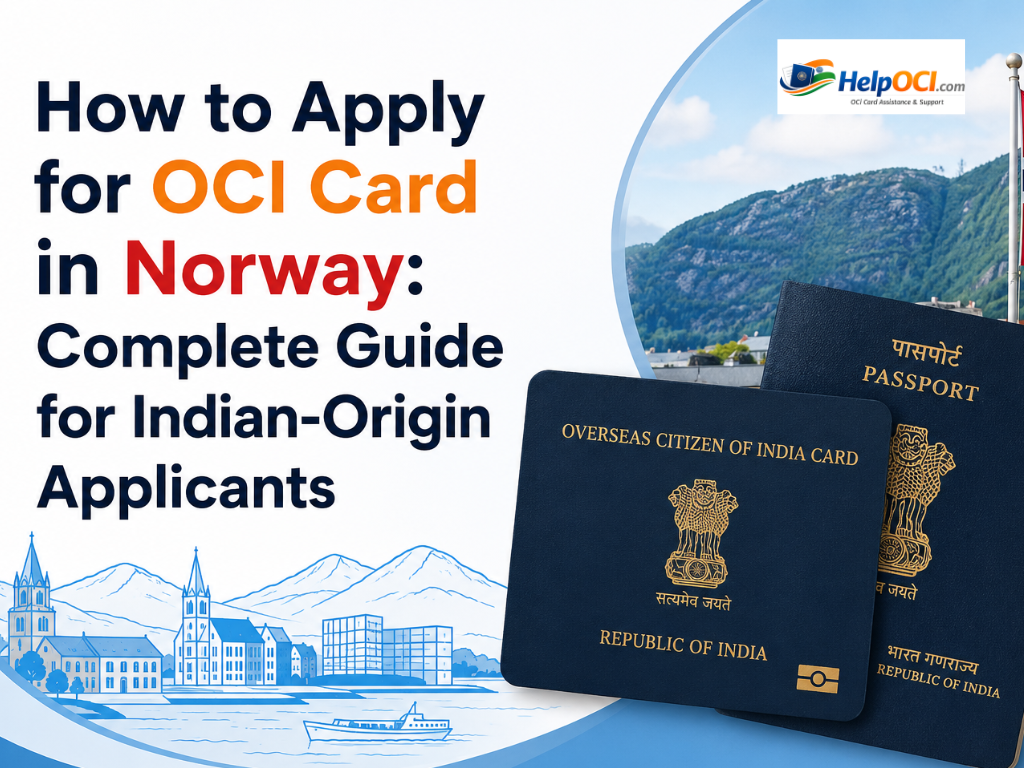
Are you planning to apply for an OCI card from Norway but feeling uncertain about the process, required documents, or timeline? You are not alone. Many applicants of Indian origin in Norway face challenges with OCI applications due to minor document errors and unclear guidelines. This comprehensive guide by HelpOCI explains everything in a simple, step-by-step format. Enabling you to apply confidently, avoid rejection, and save valuable time.
What is an OCI Card?
An Overseas Citizen of India (OCI) card is issued to foreign citizens of Indian origin. It allows visa-free travel to India and provides multiple long-term benefits for Non-Resident Indians (NRIs) and foreign passport holders connected to India. An OCI card is often regarded as a lifelong visa for India, allowing multiple entries without the need to repeatedly apply for Indian visas.
Key Benefits of an OCI Card
- Multiple-entry lifelong visa for India
- No need for separate Indian visa applications
- Permission to stay in India for an unlimited duration
- Easier travel for family visits and business purposes
- Parity with NRIs in several economic and educational matters
- Simplified immigration clearance in India
For Indian-origin families living in Norway, an OCI card offers convenience, flexibility, and long-term travel security.
Who Can Apply for OCI Card from Norway?
You may be eligible for an OCI card in Norway if:
- You previously held Indian citizenship
- One of your parents or grandparents was an Indian citizen
- You are a minor child of Indian-origin parents
- You are a spouse of an Indian citizen or OCI holder (subject to eligibility conditions)
You cannot apply if:
- You or your parents/grandparents were citizens of Pakistan or Bangladesh
- You submitted incomplete or mismatched documents
- Your nationality status conflicts with OCI eligibility rules
Before starting the application, it is crucial to verify your eligibility carefully, as incorrect category selection is one of the major reasons for OCI application delays. learn more about how to apply for eoci card.
'
Documents Required for OCI Card in Norway
Understanding the documentation requirements is a critical part of applying for an OCI card in Norway. The specific documents may vary depending on whether you are applying as A:
- former Indian citizen
- child applicant
- spouse applicant
- minor applicant
However, the commonly required documents include:
Basic Documents Required
- Current Norwegian passport
- Copy of previous Indian passport (if applicable)
- Renunciation certificate of Indian citizenship
- Proof of Norwegian residence
- Passport-size photograph as per OCI specifications
- Signature or thumb impression
- Address proof
- Birth certificate (for minors)
- Marriage certificate (for spouse category)
Important Tips
All uploaded documents should be:
- Clear and readable
- Properly scanned
- Uploaded in the correct size and format
- Consistent with the information entered in the application form
Even small spelling differences between documents can trigger objections or delays.
Step-by-Step Process to Apply for OCI Card from Norway
Many applicants make mistakes by rushing through the application process. Following a structured approach can help avoid unnecessary issues. Here is the complete step-by-step process:
Step 1: Check OCI Eligibility
Before filling out the application, confirm your eligibility category to avoid rejection or resubmission requests. Verify:
- Indian-origin relationship proof
- Passport validity
- Renunciation status
- Supporting documents
Step 2: Fill Out the OCI Application Form Online
The OCI application form must be completed online. While filling out the form:
- Enter details exactly as they appear on your passport
- Avoid spelling mismatches
- Double-check date formats
- Upload your photo and signature carefully
- Review every section before submission
Many OCI applications experience delays due to simple data-entry errors.
Step 3: Upload Required Documents
Applicants must upload scanned copies of the required documents. Common upload mistakes include:
- Cropped passport scans
- Blurry documents
- Incorrect file size
- Wrong photo background
- Signature mismatch
Many applicants seek guidance from professional OCI assistance platforms like HelpOCI to ensure proper formatting and document preparation.
Step 4: Pay OCI Application Fees
OCI fees in Norway may vary depending on:
- Fresh OCI applications
- CI miscellaneous services
- Re-issuance cases
Always verify the latest fee structure before payment. Keep payment receipts safely, as they may be required during the appointment process.
Step 5: Book an Appointment and Submit Biometrics
After online submission, applicants may need to schedule an appointment for physical document verification and biometrics. During the appointment:
- Carry original documents
- Bring photocopies
- Ensure photo specifications match requirements
- Arrive on time
Applicants applying for minors should also verify additional parent consent requirements.
Step 6: Track Your OCI Application Status
After submission, applicants can track their OCI application status online. Typical status stages include:
- Acknowledged
- Under processing
- Printed
- Dispatched
- Ready for collection
By following this guide, you can streamline your OCI application process in Norway.
H2: OCI Processing Time in Norway
One of the most frequently asked questions is about the duration of the OCI process. In most cases, OCI card processing in Norway may take several weeks. However, timelines can vary due to several factors:
- Incomplete documents
- High application volume
- Additional verification requirements
- Passport inconsistencies
- Technical upload errors
Applicants who submit complete and properly verified documents typically experience smoother processing.
Common Mistakes to Avoid During OCI Application
Many OCI applications face delays because applicants overlook small details. Here are some common mistakes to watch out for:
- Incorrect Photo Specifications: Photo rejection is very common in OCI applications.
- Name Mismatch Across Documents: The names on your passport, birth certificate, and Indian documents should match.
- Uploading Unclear Scans: Blurred or cropped documents may lead to objections.
- Wrong Signature Format: Digital signatures that do not meet specifications may be rejected.
- Incorrect Eligibility Category: Choosing the wrong OCI category can complicate processing.
These can be small issues, but they can significantly delay approvals. Many applicants prefer to seek expert review support.
Why Applicants from Norway Choose Professional OCI Assistance
OCI applications involve various technical documentation, formatting requirements, and verification standards. For this reason, many applicants choose expert assistance platforms like HelpOCI.
How HelpOCI Supports Applicants:
- Guidance on OCI eligibility
- Document checklist support
- Photo and signature verification
- Assistance in reducing errors
- Application review support
- Help with complicated cases
For applicants applying from Norway, professional guidance can simplify the overall experience and reduce avoidable delays.
OCI Card for Children in Norway
Parents applying for OCI cards for children should pay extra attention to documentation. The commonly required documents for minors include:
- Child’s foreign passport
- Birth certificate
- Parents’ passports
- Parents’ OCI or Indian documents
- Address proof
- Consent documents
Minor applications are often delayed due to incomplete parent documentation or inconsistent details on birth certificates.
'
OCI Renewal and Re-Issue Rules
Applicants should understand the requirements for OCI re-issuance. In certain situations, OCI cards may need to be updated after:
- Passport renewal
- Changes in personal details
- New photograph requirements
- Category updates
Keeping OCI information up to date helps avoid future travel complications.
Is OCI Better Than an Indian Visa?
For Indian-origin citizens living in Norway who travel frequently to India, an OCI is usually more convenient than repeatedly applying for visas.
OCI Card VS Regular Indian Visa
| Oci Card |
Regular Indian Visa |
| Lifelong validity |
Limited validity |
| Multiple Entry |
Repeated application required |
| Long-term convenience |
Frequent renewals |
| Faster Travel flexibility |
More paperwork |
'
Conclusion
Applying for an OCI card from Norway is much easier when you understand the process clearly and prepare your documents correctly from the outset. Small mistakes can lead to significant delays, which is why applicants often prefer the expert guidance of HelpOCI. With the right support, you can complete your OCI application smoothly, avoid rejection risks, and secure hassle-free travel and long-term connectivity with India.DisclaimerNote: This guide is for information purposes only. HelpOCI or the author will not be responsible for any direct or indirect loss incurred by the reader for taking any decision based on the information or the contents. It is advisable to consult a qualified professional for guidance based on your exact situation.





Comments